1
Bending or Displacement
Moving snow and ice can place lateral force against an exposed pipe or chimney, creating the potential for the penetration to bend or move.
Vent pipes, chimneys and similar roof penetrations can become vulnerable obstacles when accumulated snow and ice begin moving down a sloped metal roof.
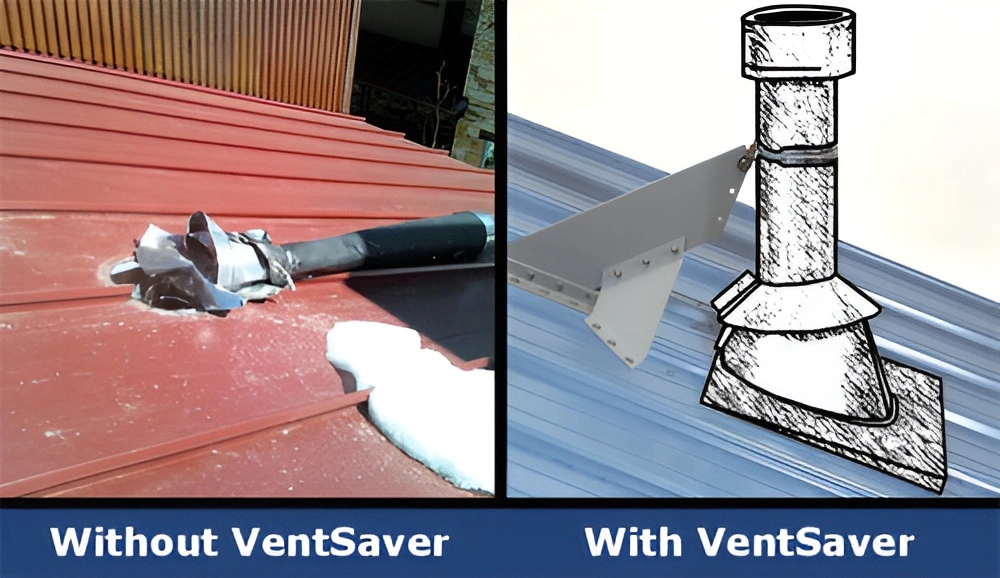
Snow resting on a roof is not necessarily the same condition as snow that has begun moving.
On a smooth metal roof, accumulated snow and ice can begin sliding downslope as roof conditions change. When that moving material reaches a vent pipe or chimney, the penetration becomes an obstruction directly in its path.
The resulting force can be directed against the upslope side of the pipe, chimney or its supporting components.
Metal roofing provides a comparatively smooth surface. Accumulated snow can therefore move across the roof rather than remaining fixed in place.
Changes in temperature, sunlight and roof conditions can contribute to snow and ice releasing and moving downslope.
A vertical penetration extending above that surface can then become one of the first obstacles encountered by the moving snow.
Moving snow and ice can place lateral force against an exposed pipe or chimney, creating the potential for the penetration to bend or move.
Movement of the penetration can also affect components where the pipe or chimney passes through the roof.
Sliding snow and ice can reach the base of the penetration and damage the pipe base or roof boot if the area is not properly protected.
Vent protection can be relevant anywhere a vertical pipe, chimney or similar penetration projects into the path of moving snow and ice.
Penetration height, diameter, roof pitch, roof type and the amount of snow encountered can all affect the protection requirements.
A purpose-built vent protection device is intended to address the penetration itself.
The VentSaver approach combines two functions:
This is fundamentally different from simply placing a few conventional snow guards immediately above the pipe.
Snow-retention systems are intended to manage accumulated snow over a broader roof area, while vent-protection devices concentrate on protecting an individual penetration.
The way a protection device attaches to the roof depends on the type of metal roofing system.
Standing seam roofs generally use concealed fasteners and are designed to allow panel movement. A compatible clamp-mounted system can provide a nonpenetrating attachment without drilling directly through the floating panel.
Learn about standing seam vent protection →
Exposed-fastener roofs can use mechanically fastened mounting methods, but the fasteners need adequate structural material beneath the metal panel.
The thin roof sheet itself should not be treated as the only structural attachment point.
The next step is understanding how a dedicated vent protector redirects moving snow while also supporting the roof penetration.